long-term commitment
For more than 40 years, the New Mexico Community Foundation has helped communities turn local vision into lasting change. From its beginnings within HELP to its growth as a statewide philanthropic leader, the foundation’s history is rooted in partnership, resilience, and a deep belief in New Mexico’s people and places.
- Unlike place-based foundations centered on a single city or county, the foundation was designed to serve communities across New Mexico—especially rural, tribal, frontier, and historically overlooked places.
- From HELP’s steering committees to donor collaborations and community-led grantmaking, the foundation’s history reflects a belief that lasting change comes from working with communities—not for them from a distance.
- Early grants were often small, but they helped launch local projects, attract matching support, and create the conditions for broader community transformation over time.
- Whether navigating lean years, building an endowment, rebranding, or responding to a pandemic, the organization has continually adapted while staying anchored to its founding values.
- What began as an idea within HELP became a statewide institution grounded in generosity, local leadership, and the belief that every New Mexico community deserves the opportunity to thrive. The history of the New Mexico Community Foundation is not only a record of milestones—it is a living story of communities building their future together.
This history is adapted from the personal account and research of José A. Rivera, Professor Emeritus, School of Architecture and Planning, University of New Mexico.
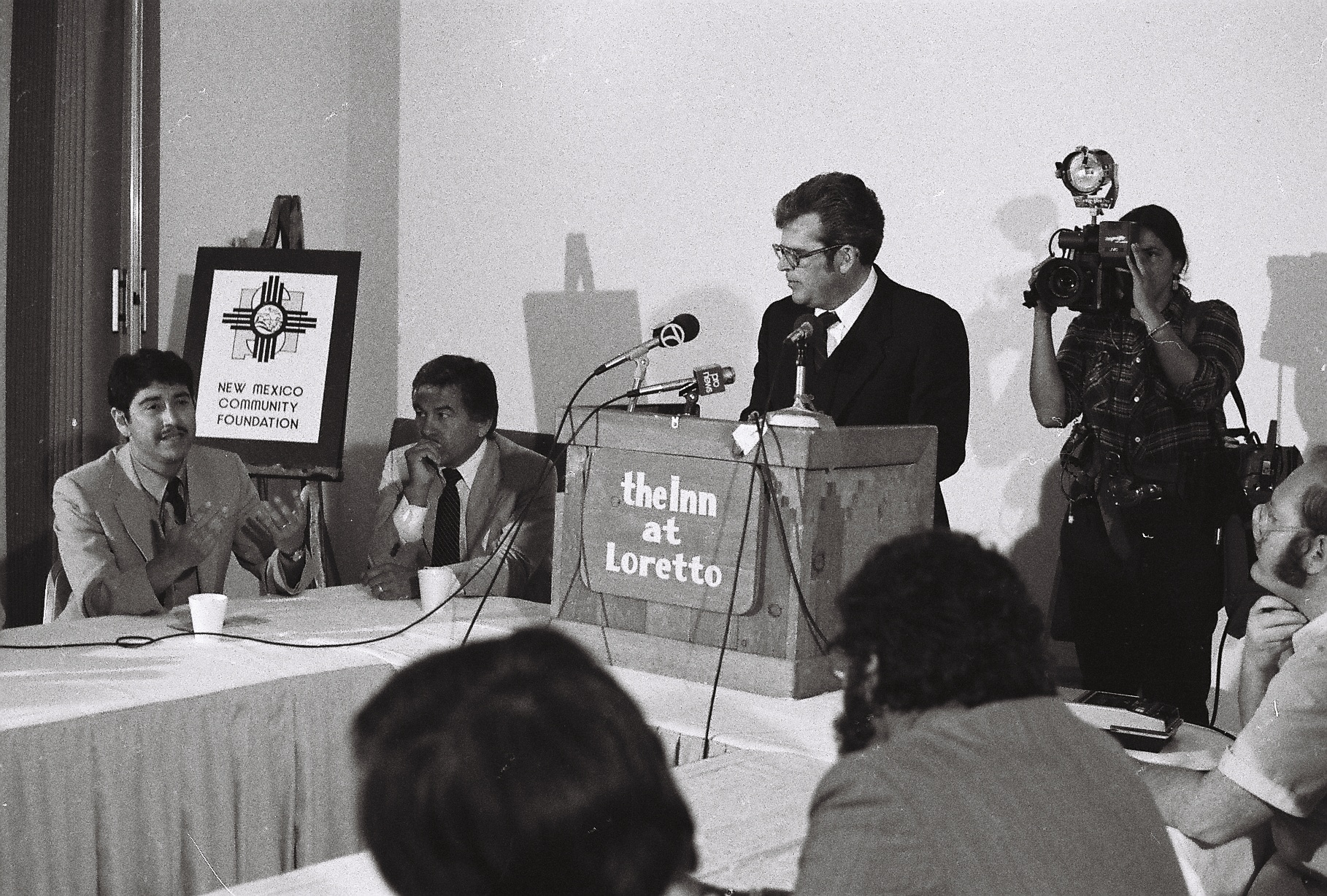
José Rivera (far left), Gov. Jerry Apodaca (middle), and Bruce Rolstad (at the podium) at a New Mexico Community Foundation
press conference in 1980.
HELP (Home Education Livelihood Program) builds a statewide rural development model rooted in local leadership, education, economic opportunity, and community self-determination. By the mid-1970s, its work across New Mexico demonstrates how seed funding and community partnerships can create lasting local institutions.
After consultant Sandy Kravitz encourages HELP to expand its “developer approach,” José A. Rivera begins exploring the creation of a statewide foundation for New Mexico. Drawing on national community foundation models, HELP develops plans for what would become the New Mexico Community Foundation.
The New Mexico Community Foundation begins as a corporate division of HELP, operating with interim leadership, volunteer energy, and in-kind support. Bruce Rolstad serves as the first Executive Director in this formative period, while early trustees and supporters shape the mission and begin outreach across the state.
Former Governor Jerry Apodaca helps publicly announce the New Mexico Community Foundation, signaling a statewide vision: to connect charitable giving with the needs of rural towns, villages, and underserved communities across New Mexico.
On May 3, 1983, the New Mexico Community Foundation is formally incorporated as an independent nonprofit. Founding leadership includes Susan Herter, José Rivera, Ernest “Gene” Ortega, Fred O’Chesky, Fred Schwendimann, Ron Van Amberg, Janet Susco, and Marilyn Sandford.
In its lean early years, the foundation supports grassroots projects with modest but strategic grants. A major breakthrough comes with the Churches Project, an ambitious community-based preservation effort that restores historic adobe churches while strengthening civic pride, volunteerism, and local capacity. The project later becomes Cornerstones Community Partnerships.
With support from partners including Ford, McCune, and Thaw, the foundation grows its endowment and increases grantmaking. Rural initiatives, technical assistance, and donor partnerships help deepen the foundation’s presence in communities across all regions of New Mexico.
The foundation broadens its portfolio to include rural development, youth, education, food systems, women and girls, Native initiatives, emergency response, animal welfare, and fiscal sponsorship. By its 30th anniversary, it has distributed tens of millions of dollars and served all 33 counties.
The organization adopts the name New Mexico Foundation to underscore its statewide identity and mission of strengthening communities throughout New Mexico.
During and after the COVID-19 pandemic, the foundation mobilizes major relief and recovery efforts, including Native American Relief Fund support, broadband equity initiatives, and health and asylum-related funds. Its 40th anniversary highlights four decades of trust-based, community-centered philanthropy.
Under new leadership, the foundation announces a return to the name New Mexico Community Foundation—reaffirming that “community” remains at the heart of its mission, identity, and future.